
How to Find Who Owns a Juab County Property
The clean path moves from address to parcel. It then runs from the parcel to the Assessor's owner association, and from that name to the newest deed in the Recorder's index. The parcel ID holds the thread. It keeps every source pointing at the same land. If a sale just closed, the recorded deed is the stronger evidence of the transfer. Juab publishes no fixed interval for refreshing the Assessor roll. Treat the deed as the finish line. The parcel number is your guide along the way.
- Search Juab EagleWeb or the county’s property-search page by the full address and municipality.
- Record the parcel ID or serial number, the owner association, and the separate mailing and situs addresses.
- Search the Recorder’s index for the most recent deed and compare the grantor, grantee, date, and legal description.
- If an entity, trust, estate, or representative is named, treat that recorded name as the owner clue and verify the instrument.
Read the Juab County Assessor Record, Then the Deed
According to the county, the Assessor classifies property. It also associates ownership with parcels and sets taxable value. The Recorder stores and indexes deeds and maintains ownership plats. A parcel record is where discovery starts. The deed is the instrument that actually supports the named conveyance. Always check the legal description. Do not treat the owner's name as enough to identify the property.
Juab EagleWeb is the public property-search entry point for the county. Its live card labels and deed search controls are best confirmed on the site itself before you rely on a particular field. The county's own description of ownership plats lists what the Recorder maintains: ownership, acreage, parcel address, taxing units, and owner address. That makes the plat a useful cross-check. It helps when a search result leaves the parcel's identity unclear.
Where Juab County Owner Information Comes From
Ownership research in Juab County draws on several record types at once. The Assessor association locates the parcel. The Recorder's instrument confirms the transfer. GIS and UGRC data explain the land's geography. The Treasurer's account answers tax-billing questions but is not a deed index. No single result should carry the whole load of proving ownership, tax status, value, and boundaries all at once.
| Source | Owner Info It Gives | Access |
|---|---|---|
| Assessor record | Ownership association, parcel classification, and taxable value. | Juab EagleWeb / Assessor |
| Recorder index and deed | Recorded parties, date, legal description, and instrument reference. | Juab EagleWeb or Recorder request |
| Ownership plat | Ownership, acreage, parcel address, taxing units, and owner address as described by the county. | Recorder plat or copy request |
| GIS / UGRC parcel data | Parcel geometry and identifiers, with additional LIR attributes where populated. | CloudSmartGIS / SGID |
The owner of record is simply the party named in a property or deed record. An occupant is not always the owner. Public parcel records say nothing about who lives at an address. A mailing address is a tax-contact clue. It is not a promise that the owner resides on the parcel. Confirm any name match with the parcel ID and legal description. Do not treat it as settled before that.
Juab's Recorder points to the ownership plat for ownership and acreage. It also covers parcel address, taxing units, and owner address. It helps when an assessor result does not explain how a parcel is identified. It remains a county record rather than a title opinion. The published copy schedule lists a $2 fee for an ownership plat up to 18 by 18 inches. A 24-by-36-inch survey or subdivision plat costs $4. Ask the Recorder which document fits your question.
Match a Juab County Owner to the Correct Address
Juab's towns use separate address origins. So the municipality matters when you match an owner to an address. Nephi uses Center/Main and Highway 41. Mona uses Center/Main and Highway 91. Levan uses Center/Main and Highway 28, while Eureka and the West Grid have origins of their own. An address may carry an older highway label or a rural mailing city. Include the town name and check a parcel identifier too.
Situs is where the parcel physically sits. The mailing address is where tax notices go. Some owners live elsewhere. Others use a post-office box or hold agricultural land. Their mailing address may sit far from the parcel. Do not read the mailing line as evidence of residence or identity beyond what the public record shows.
Nephi's 2019 Jones Annexation plat shows why a city label makes a poor ownership key. It describes 56.28 acres. It also identifies parcels XB2127-2, XB2127-1, XB2129-1, and XB2131 near Hunters Meadow and the Main Highway area. Those parcel references work as a map and planning lead. The latest Assessor association and Recorder deed still decide the county record trail for each parcel.
The Assessor name and the deed grantee may differ. Compare effective dates and parcel descriptions before assuming one entry is wrong. A deed may describe a parent tract before a subdivision split. The current tax record may use a newer parcel identifier. For a recent transaction, the Recorder's recorded instrument shows the conveyance that was filed. The Assessor can say whether its parcel ownership association has caught up.
When a Juab County Property Owner Is an LLC, Trust, or Estate
Sometimes the owner of record is not a person at all. A Juab County deed can name another party. It may be an LLC, a trustee, an estate, or a personal representative. Copy the legal name exactly as recorded first, then match it against the parcel description. The entity name identifies the party on the deed. It does not list every beneficiary or person connected to the entity. Utah's business-entity lookup offers a separate way to see who stands behind a company name.
Estate transfers can involve probate too. A transfer may require both the probate record and a recorded deed or distribution instrument. Utah keeps recent death certificates private for 50 years, subject to limited access rules. FamilySearch lists historical Juab wills from 1861 through 1888. The Recorder remains the source for recorded transfers.
The county Assessor's official department page covers its duties.
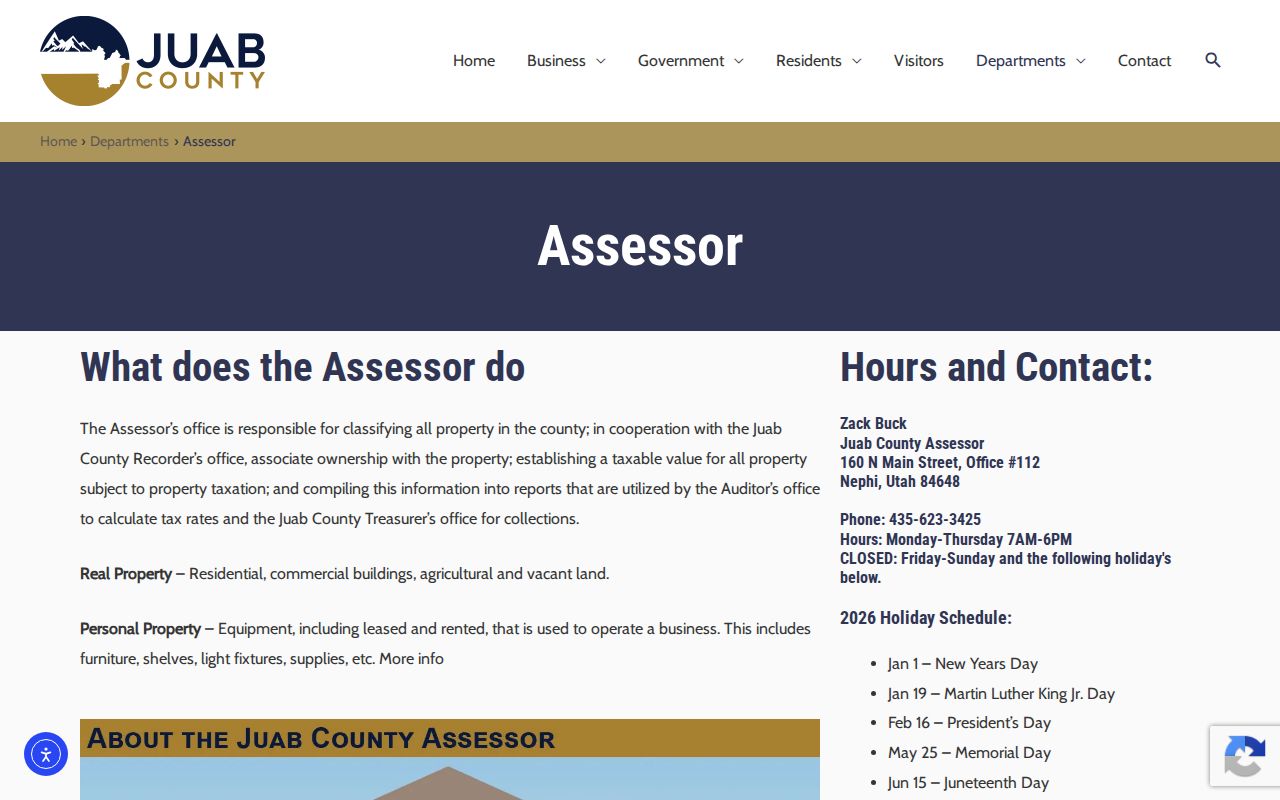
Use that page to understand the Assessor's function. When the question is whether a transfer was recorded, the Recorder's deed index is the better tool.
What a Juab County “Who Owns” Search Cannot Prove
The public record names an owner of record. It lists the parties on recorded deeds. What it cannot do is confirm who occupies a building, reveal private details outside the record, or guarantee a complete chain of title. Records can also lag or contain errors. The Recorder states plainly that it performs no title searches and interprets no legal documents.
Lawful use. An owner lookup is for property research, boundary questions, and due diligence. Do not use public owner information to stalk, harass, threaten, or harm anyone; contact the custodian about any redaction process that may apply.
Check a Recent Juab County Owner Change With the Recorder
The Assessor’s ownership roll can lag behind a just-completed sale, and the county publishes no refresh interval. When timing matters, search the Recorder’s deed index. Compare the grantor, grantee, recording date, and legal description. If the newest instrument does not appear, ask the Recorder whether a pending entry exists. An older index entry is also worth asking about. An unchanged Assessor result is not proof that nothing transferred.
Juab EagleWeb also carries a Fraud Notify link for property-fraud monitoring. The signup workflow is not shown on the public landing page. So visit the county portal directly or call the Recorder at 435-623-3430 to confirm the current process. Keep any notice with its parcel and document reference. Verify it through the official office rather than an unsolicited payment link.
If the record stays unclear, a focused GRAMA request can help. It can seek an existing deed, ownership plat, index entry, or related record. Name the parcel and date range. Utah’s guidance says the agency should respond as soon as reasonably possible. That is generally within 10 business days. The agency can also charge actual costs for copies or staff search time.