
What Juab County Property Tax Records Separate
Three offices split the job. The Juab County Assessor classifies property, matches ownership to parcels, and sets taxable value. The Treasurer handles collection and tax-account status. County tax pages point to the account-search route. Its live fields do not always display. Keep the valuation record separate from a current bill and from any recorded sale.
| Field | What It Shows | Where |
|---|---|---|
| Market value | Assessor’s full fair-market estimate before residential exemption. | Juab Assessor / parcel data |
| Taxable value | Value remaining after any applicable exemption. | Assessor record |
| Tax bill and account | Amount billed, payment, or delinquency information. | Juab Treasurer account route |
| Tax district | District assignment associated with the parcel. | UGRC LIR / county account |
| Sale notice | Published delinquent-tax-sale terms and parcel description. | Juab County tax-sale page |
Utah exempts 45% of fair market value on a primary residence. The remaining 55% is the taxable level. The local tax rate then applies to it. A second residence or unoccupied residential property is generally taxed at its full market value. A bill reflects the taxable account plus local charges. It does not show what a buyer would pay. The Assessor’s figure also differs from deed consideration recorded in a transfer.
Juab County Property Tax Records Come From Separate Offices
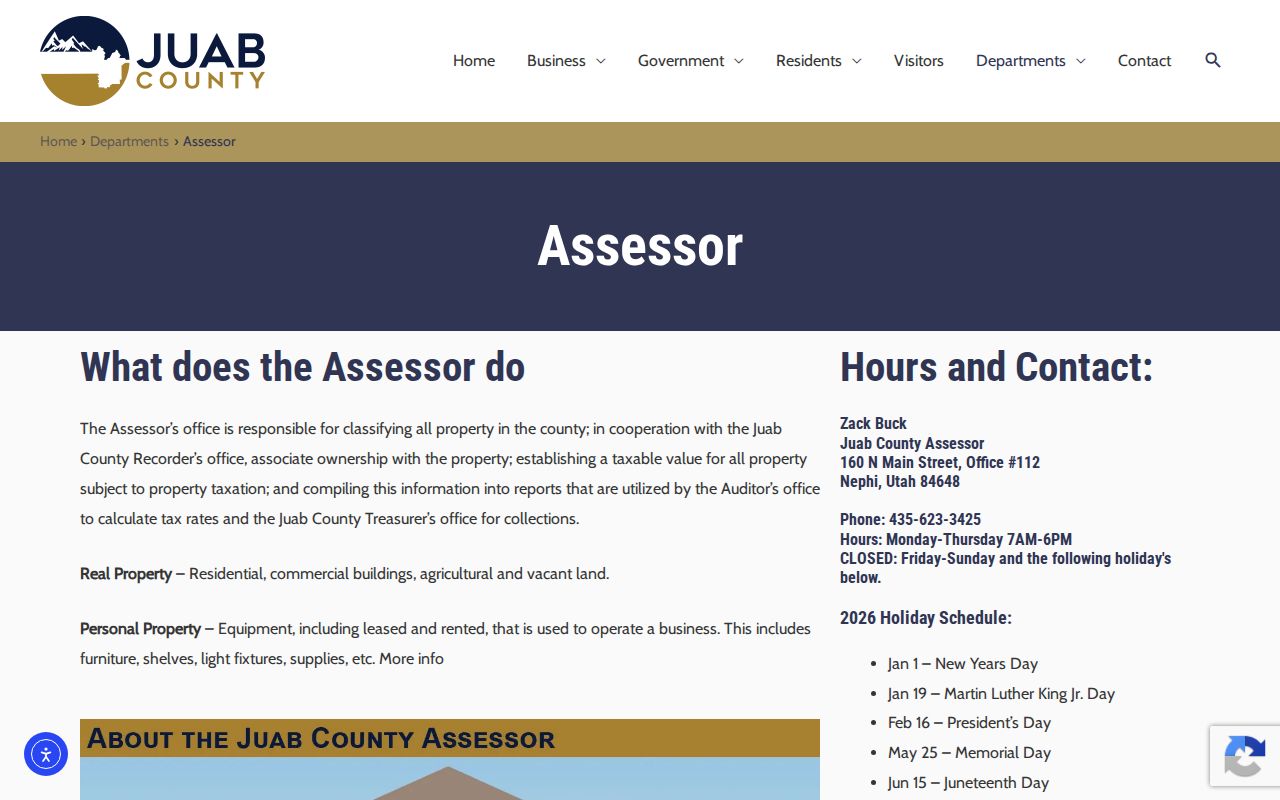
The Juab County Assessor determines classification, links ownership to property, and establishes taxable value. The Recorder stores the deeds and plats behind the land record. The Treasurer collects taxes and manages the account side. This division matters when one screen seems to contradict another. A deed records a transfer. An assessment sets a taxable value. A Treasurer account shows billing or payment status. The Juab County Assessor department page lists the office’s duties and contact information.
The county’s assessment explainer ties property-tax information to the Treasurer account search. The account host’s live controls sit behind its own page. The county assessment-information page is the best starting point for the Treasurer account link.
Take classification and value questions to the Assessor. Bring the bill, payment, or delinquency question to the Treasurer.
Juab County Taxable Value and the Utah 45% Exemption
Utah appraises locally assessed property at 100% of fair market value. A qualifying primary residence gets a 45% residential exemption, leaving 55% taxable. The 2023 statistical report shows the same 100% assessment level. It lists 55% as the taxable level for primary residential property. Those percentages explain the gap. A market-value figure and the taxable value on a bill can differ substantially.
The exemption covers one primary residence per household. Utah rules may require an application with the county Assessor. A second residence or unoccupied residential property is generally taxed at the full value. Never infer exemption status from a name appearing as owner of record alone. Check the parcel's tax classification and ask the Assessor which record controls.
Other classes, including agricultural and vacant land, need their own classification review. Juab's property data may carry a property class, exemption type, tax district, acreage, and primary-residence indicator. The data follows the UGRC LIR schema. Parcel-card labels vary. The parcel number is the anchor.
Finding a Juab County Property Tax Bill
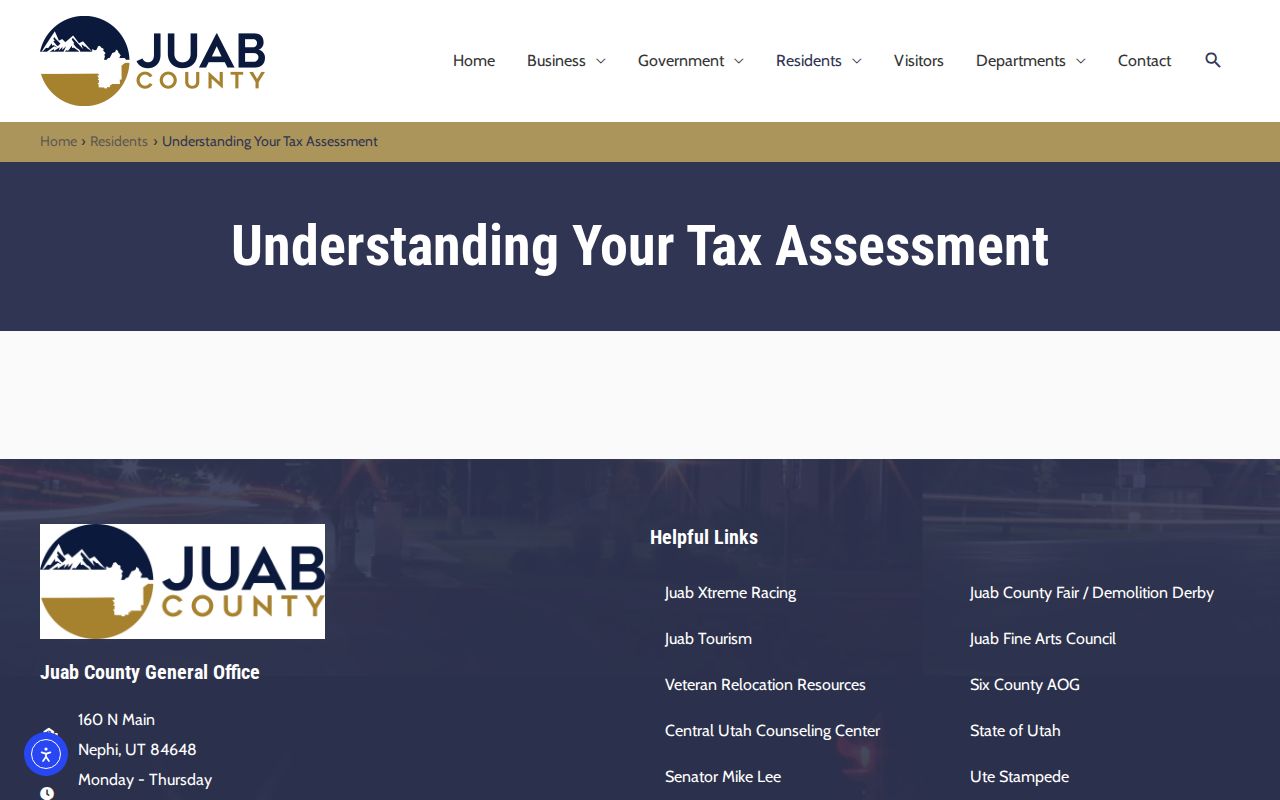
The county’s “Understanding Your Tax Assessment” page links to the Treasurer Account Search. The Treasurer department page is the official contact route. That interactive account host can be hard to reach. Use a parcel number when available. Confirm the tax year before reading any balance or status.
- Open the Treasurer Account Search link from the county assessment page.
- Identify the parcel and tax year before reading a bill, payment, or delinquency status.
- Compare any exemption or taxable-value question with the Assessor’s parcel classification.
- If the account screen is unavailable, contact the Treasurer through the county office directory or request a named existing account record.
- Market value
- The assessor’s estimate of fair market value before the residential exemption.
- Taxable value
- The value after any applicable exemption, to which tax rates apply.
- Primary-residence exemption
- Utah’s 45% exemption for a qualifying primary residence, leaving 55% taxable.
- Tax delinquency
- An account status the Treasurer handles; confirm the balance and process with that office.
The Juab County Treasurer page is the county’s department contact route for tax-account questions.
The account-search controls sit in an interactive host. Confirm any phone contact through the county’s official pages.
Juab County Property Tax Records in the 2026 Sale Notice
Juab County’s 2026 delinquent-tax-sale notice scheduled an auction. It was set for May 21, 2026 at 10:00 a.m. through PublicSurplus. It identified parcel XE00-4713-1 as Lot 12, Block 3, Plat A. That sits in the Eureka City Survey. The notice stated that bids below the delinquent taxes, notice charges, interest, and penalty would not be accepted. Administrative costs were part of that minimum too.
That is a dated example of a tax-sale record. It is not a current listing or a statement about present ownership. A sale notice helps identify a parcel and its legal description. It does not by itself prove title after an auction. For a current balance or sale status, check the county’s live notice. The Treasurer account route also works. Then inspect the Recorder for any later tax deed or other transfer. The Juab County tax-sale page carries the county notice and PublicSurplus auction link.
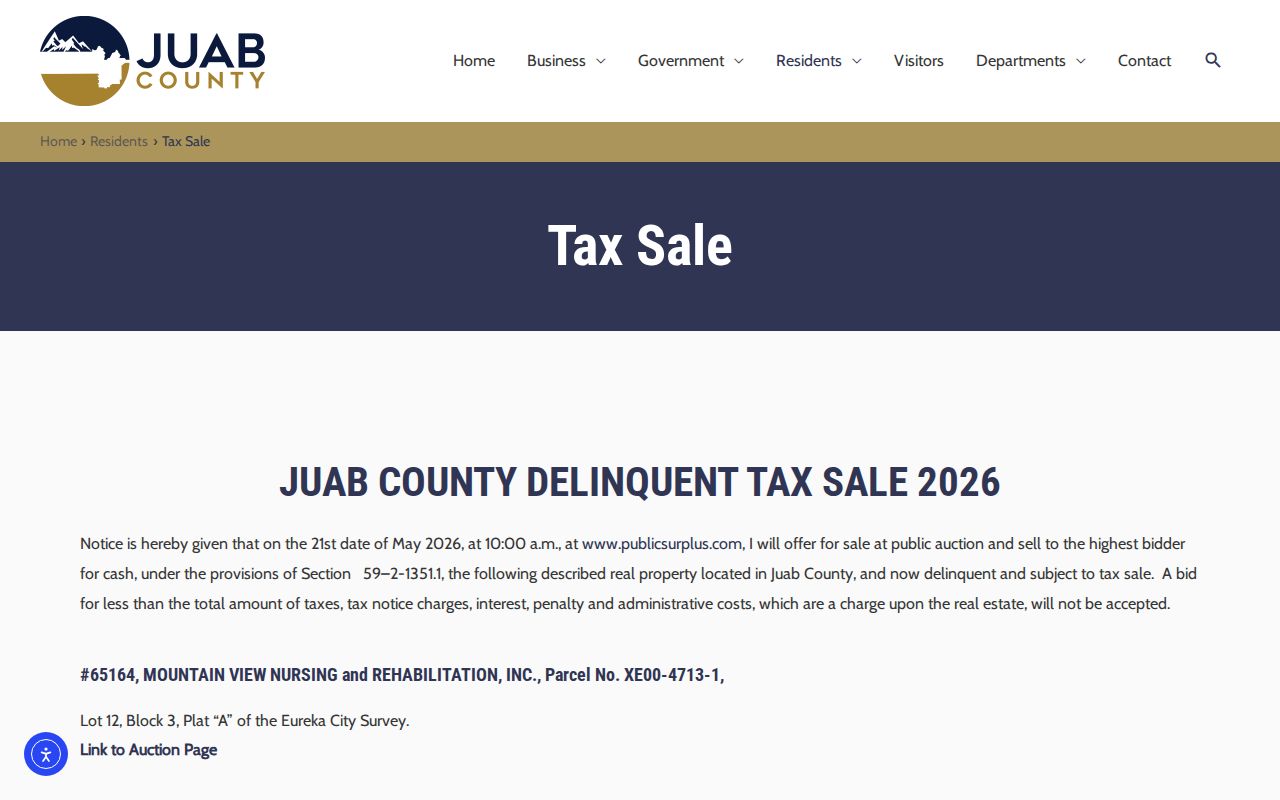
The auction date has passed. Treat this notice as a record example, and verify any active sale through the county.
Juab County Property Tax Assessment Appeals
Utah Tax Commission Publication 31 lays out how valuation appeals work. It explains what evidence counts. It also covers the statutory timing that governs each step. Juab County does not publish a local annual filing date on its own pages. Confirm the current deadline and filing steps with the Assessor before preparing anything. A date borrowed from another county or an earlier tax year is not reliable.
Build the appeal around the parcel and the value date in dispute. Keep the assessment notice handy. The parcel's classification and exemption details matter too. Evidence should speak to fair market value. That includes the parcel description, its condition or land characteristics, and comparable sales. A recent sale price is not automatically the correct assessed value. A tax bill alone does not reveal how the Assessor arrived at the number.
Every piece of evidence must match the valuation date and the property being appealed. Check each comparable sale for location, acreage, improvements, and transaction date. A big gap in acreage can make a seemingly similar parcel a poor match. So can a big difference in condition. Some disputes concern the taxable amount rather than the market estimate. Verify the property class and primary-residence exemption with the Assessor first. Those questions stand apart from whether the Treasurer shows a balance due.
Juab publishes no local appeal calendar. Ask the Assessor for the current filing form, the submission method, and the required evidence. Also confirm the date for the tax year on the notice. Keep a copy of the notice and any delivery confirmation.
Confirm the current window. Juab’s local deadline was not found in the reviewed county pages. Contact the Assessor and consult Utah Tax Commission Publication 31 for the current appeal path, evidence rules, and applicable statutory deadline.
Older Juab County Property Tax Records and GRAMA
FamilySearch's Juab collection reaches back to 1847. It runs through 1948, with a 1927 tax record among its examples. Those historical images will not show a current account balance. The same collection holds deed, mortgage, land, mining, water, and probate records. These can clarify an older assessment description or a parcel's history. Viewing images may require a FamilySearch account, an affiliate library, or a FamilySearch Center.
When a record, current or old, is not online, send a focused GRAMA request to the office likely to hold it. Name the parcel. Give the tax year, the record type, the date range, and your preferred format. Utah guidance requires the request to identify an existing record. An agency does not have to answer a question or create a new analysis. Agencies generally respond as soon as reasonably possible and no later than 10 business days. A five-business-day track exists for requests that benefit the public. Inspection is free. Copies or staff time for search and compilation may carry reasonable actual-cost charges.
A tax history that spans years works best as a series of specific requests. Ask for the annual account or assessment record you need. Keep the year printed on each document. A current parcel number may not appear in an older paper record. So add a prior owner name or legal description when you can. The Treasurer handles payments and delinquency. The Assessor explains classification and value. The Recorder locates deeds and tax-related instruments. Routing a request to the office that holds the record avoids one department certifying another's data.
Keep the record types separate. The tax account covers billing and payment status. The Assessor record covers valuation and classification. The deed records a transfer, and the GIS layer handles mapping. For value fields without the tax-bill process, see the separate Juab County property value guide.