
The Juab County Current Owner Record and Its Fields
The Assessor links an owner to a parcel. The Recorder's ownership plats add acreage, parcel address, taxing units, and owner address. Together these fields form the current owner record within Juab County property records. Screen labels can vary across parcel search tools. A field may not appear under the same name everywhere. Always weigh the data against its source.
| Owner association | Name attached to the parcel in the county ownership or tax record; exact live label unverified. |
|---|---|
| Mailing address | Owner address used for correspondence, which may differ from the parcel address. |
| Situs / parcel address | Physical property location described separately from owner address. |
| Parcel ID / serial | UGRC LIR lists PARCEL_ID and SERIAL_NUM for cross-office matching. |
| Deed reference | Use the Recorder’s index and recorded instrument; current portal labels were not captured. |
| Transfer date | Compare the latest recorded deed date; an Assessor update date is not published. |
The owner of record is not always the occupant. A mailing address works for ordinary property correspondence. It proves neither residence nor legal service. The Recorder states plainly that it performs no title searches or instrument interpretation.
When a result feels close but not conclusive, hold onto the parcel ID, record date, legal description, and owner name. Names alone are thin evidence. A shared name can attach to two different parcels or two different people, and matching the deed's description with the Assessor's parcel identifier gives the custodian something concrete to check against a possible error.
Splits complicate things further. A parcel that was split, combined, or folded into a later plat may carry a newer identifier than the deed that transferred the parent tract. Compare the plat date with the deed date. Read the legal description for lot, block, survey, acreage, and exceptions. This matters most when a familiar address appears but the conveyance describes a larger tract.
Why a Juab County Current Owner Result Can Lag
Juab County publishes no schedule for refreshing the Assessor's ownership association after a closing. A recorded deed can outrun the tax roll after a recent transfer. Check the Recorder's latest instrument if the Assessor still names the prior owner. Compare its grantee and legal description before concluding anything. Timing gaps are normal, not proof of an error.
Keep recording dates and sale dates separate. The county documents no EagleWeb last-sale field. It documents no deed-image result screen either. So treat a portal result as a lead, not a complete answer. Ask the Recorder whether a new instrument is indexed. Ask the Assessor whether the parcel association has been updated.
Confirming a Current Owner Through Juab County Records
Start with the parcel ID. Compare the county ownership association against the latest deed. The grantor and grantee names, recording date, legal description, and instrument reference should all align with the parcel in question. This check covers only the present record; the full history of prior owners belongs in the backward chain.
- Find the parcel through Juab EagleWeb or the county GIS and retain its ID or serial number.
- Read the owner association and the mailing and situs addresses as separate data.
- Search the Recorder’s index for the latest deed and verify its grantee and legal description.
- If a company, trust, estate, or representative is named, retain the recorded name and do not assume it identifies a beneficiary.
- Owner of record
- The party associated with the parcel in the county record.
- Grantee
- The party receiving the interest described in a deed.
- Vesting
- The ownership form stated in an instrument, such as joint or entity ownership.
- Mailing address
- The address for correspondence, not proof of occupancy.
How Juab County Deeds Name a Trust, Entity, or Estate
A county ownership record can name a limited liability company, trust, trustee, estate, or personal representative. Match the exact name and capacity in the deed with the Assessor association. The record names the party to the instrument. It does not reveal every owner, beneficiary, or person behind an entity. Utah's business-entity search offers separate context.
Probate often explains the capacity. An estate's deed capacity may trace to a probate order or distribution record showing how the instrument was signed. A will alone does not transfer a parcel. Utah death records stay private for 50 years, with statutory exceptions governing access. For a land transfer, look for the recorded instrument and legal description first.
Juab County Current Owner Mailing and Situs Addresses
Situs tells you where the parcel sits. Mailing tells you where the owner receives correspondence. Rural land, a nonresident owner, agricultural acreage, or a post-office box can make the two addresses look unrelated. Juab's address grids also differ by community: Nephi's Center/Main and Highway 41, Mona's Center/Main and Highway 91, and Levan's Center/Main and Highway 28 each run on distinct local grids.
Resolve street-number matches with the city and parcel ID. A postal city does not settle whether the property sits inside a municipal boundary. When jurisdiction matters, check a current county map or a recorded annexation record. That record settles the boundary question.
The Juab County Recorder's office page describes the ownership plats and recorded property documents behind the current deed trail. Those records anchor any parcel confirmation.
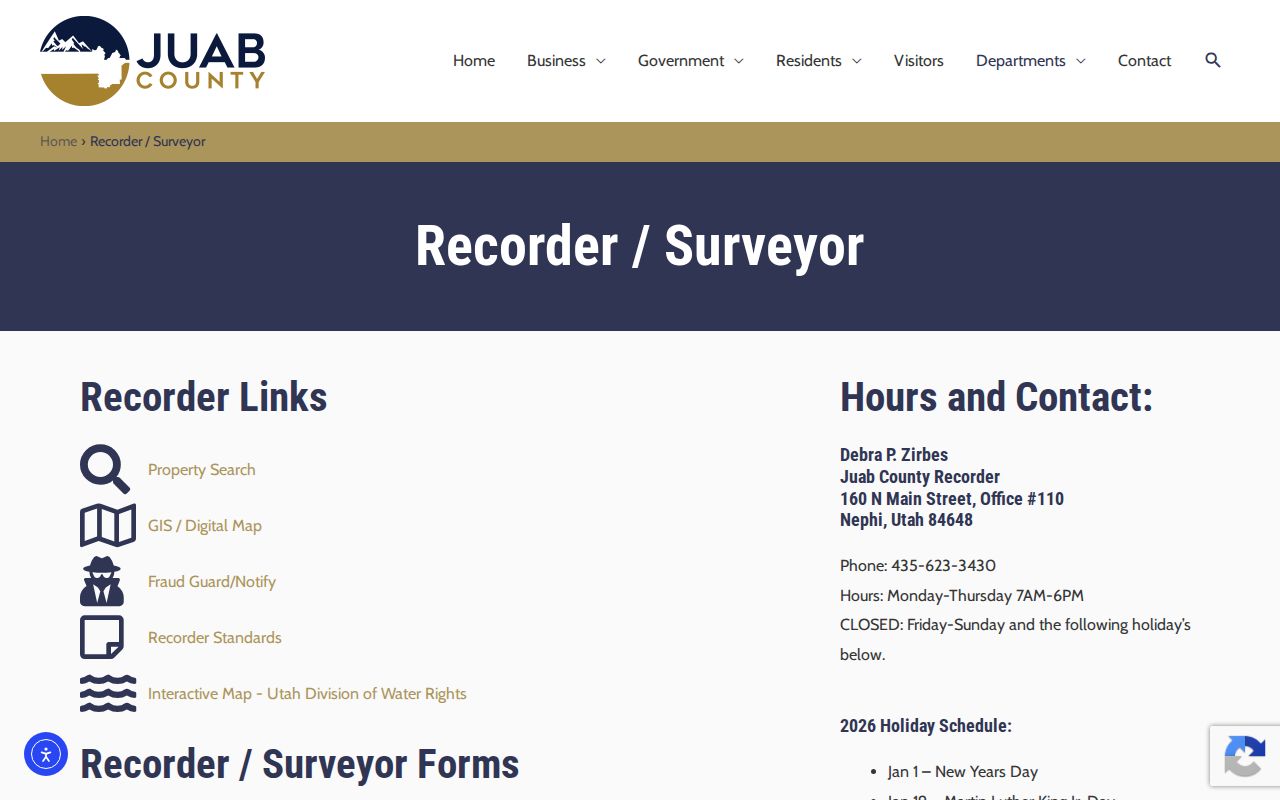
For a recent change, treat the Recorder's instrument as the transfer evidence. The Assessor's parcel record serves as the ownership association.
What the Juab County Current Owner Record Does Not Show
The public ownership association has limits. It does not prove occupancy, list private beneficiaries, or guarantee that no newer deed exists. Use the mailing address only for a lawful property matter. Privacy protections still apply. The Recorder publishes a personal-information-redaction application with a $10 fee, so ask the county about the current process and what information can be withheld.
Lawful use. Owner records support parcel research and ordinary property matters. Do not use an address or ownership result to stalk, harass, threaten, or harm anyone.
The Juab County Recorder publishes an application for personal-information redaction. The office lists a $10 processing fee. Ask the office about current eligibility. Also ask which fields can be withheld under the program. A redaction request is separate from fixing an inaccurate ownership record. To correct an entry, identify the instrument or parcel record involved. Then ask the responsible custodian how the change can be reviewed.
Resolve a Juab County Current Owner Record Gap
Juab EagleWeb carries a Fraud Notify link for property-fraud alerts. The signup steps are not exposed there, so verify enrollment through the portal or call the Recorder at 435-623-3430. The office sits at 160 N Main Street, Office 110, in Nephi, open Monday through Thursday from 7:00 a.m. to 6:00 p.m. The Assessor works out of Office 112 at the same address. Its department page lists 435-623-3425, but EagleWeb shows 435-623-3428, so confirm which number is live before calling.
Some records never make it online. When a deed, ownership plat, or assessment record is missing from the portal, a written GRAMA request can name the parcel, the date range, and the specific document sought. Utah guidance is clear on this point: a request should identify existing records rather than ask an office to craft an opinion about ownership. For a full title conclusion, a professional title search remains the right source. The Juab County Recorder does not perform that service.
A request that spans two offices works best when split in two. Send the Recorder one focused request covering the deed or ownership plat, and send the Assessor a separate one for the parcel's valuation and ownership association. Response times are set by rule. Offices must generally answer no later than 10 business days, and a shorter five-business-day track applies to requests that benefit the public. Expect possible actual-cost charges for copies or staff search time.